-
9 December 2025
What does it take to build resilient urban precincts for the next generation? Great precincts are purposeful, place-connected, and adaptable, shaped not only by infrastructure and policy but also by the people who will live, work and move through them well into the future.
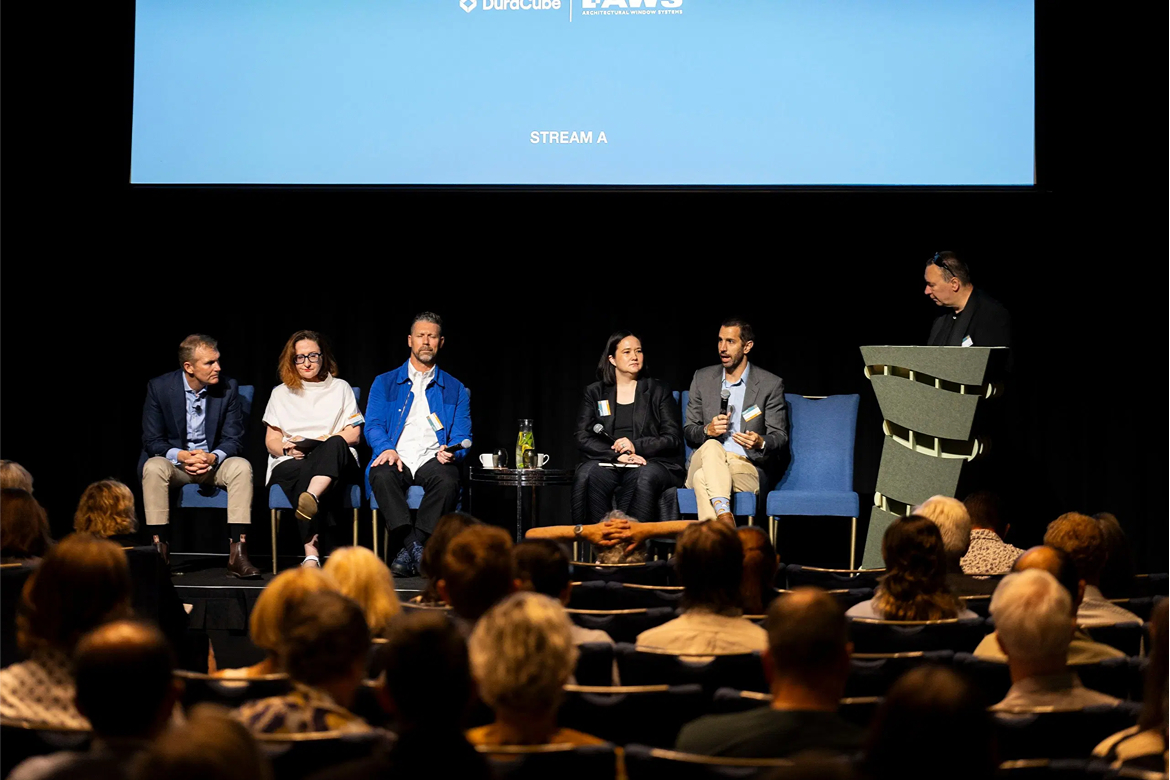
At the Sustainability Summit 2025, a distinguished panel of experts discussed the strategies that underpin the design of sustainable, inclusive, and future-ready urban precincts. Moderated by Architecture & Design Editor Branko Miletic, the panel featured Dr Rob Stokes, Group Executive for Housing, Anglicare and former Planning Minister; Annie Tennant, Director, NSW Department of Planning, Industry and Environment; Jonathan Knapp, Director, SJB; Jenna Keyes, Principal, Cities and Places, Urban Design, GroupGSA; and Paul Himberger, Associate at HIP V. HYPE.
Designing tomorrow: What makes a precinct truly future-ready?
“You’ve got to have a purpose,” says SJB Director Jonathan Knapp, be it a problem that demands a solution, the ambition for the project, a policy objective, a need within the community, or just a fundamental requirement of a specific place. Purpose comes from listening to the community and understanding the needs of the place to be able to set the framework and move forward.
Building on Knapp’s views, Annie Tennant from the NSW Department of Planning, Industry and Environment singles out connection to place as underpinning the delivery of everything from high-quality public spaces to the architectural form. Equally essential is embedding elements that battle climate change and deliver sustainability benefits such as water positivity, embodied carbon reduction, energy efficiency, carbon neutrality and a sophisticated approach to waste, both during construction and through a precinct’s lifetime.
For Anglicare Group Executive for Housing Dr Rob Stokes, safety is non-negotiable because “you’re not going to attract people unless they feel safe”. A woman’s perception of safety is different from that of a man; however, it’s often men who design public spaces. Safety, he points out, is not lights – safety is actually people.
Another imperative is the history of the place, however ancient, layered or contested it may be. “You’ve got to understand the history of the place to create the most authentic places.”
Agreeing with Dr Stokes, GroupGSA Principal Jenna Keyes says appreciating the history and trying to embed that to enable a transitional change really does help build local identity as well.
“It’s the right typology, the right zoning, the right diversity of uses, all that stuff feeds together so that you can create that safety, you can solve those water waste challenges, you can respond to the vision and the identity of that community,” says Paul Himberger of HIP V. HYPE. “Working towards that balance is really critical.”
Navigating trade-offs in urban precinct planning
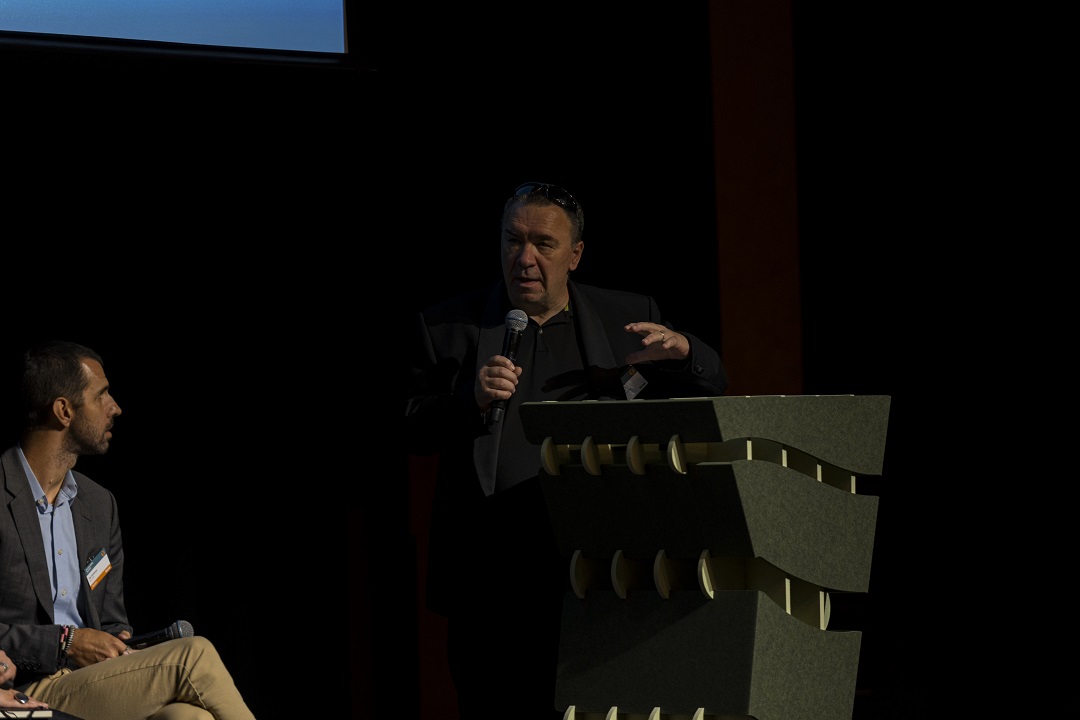
The discussion shifted quickly to the sensitive trade-offs required to achieve developmental ambitions, and how even well-intended decisions may have unintended consequences.
Dr Stokes recalls an instance from his time as the NSW Education Minister when eucalyptus trees in school precincts, planted in the 1980s as part of a program to promote Indigenous species, had to be cut down because they shed branches and were not safe for schoolyards. Similarly, the tall trees planted at Leppington Station don’t provide shade and also drop branches, making then unsuitable for public spaces. “Ultimately, what’s the tree there to do? It’s to provide shade,” he says, making a case for tree species that are fit for the purpose.
Tennant offers Barangaroo as a compelling example of balancing density and open space. There was a huge backlash from the public against the high density in the southern part of the precinct. However, the community came around eventually after experiencing what that density has delivered in terms of vibrancy, open space and precinct-wide infrastructure. “It’s the first carbon-neutral precinct of its scale in Australia, if not the world, and so, you’ve got to have a balance,” she says.
Weighing in on the trade-off debate, Knapp refers to NSW’s Transport-Oriented Development (TOD) program in the context of Ku-ring-gai in northern Sydney where more than 24,000 new homes will be built around existing train stations. Observing that “less than 1% of their local government area will be providing housing for the next generation”, he hopes that the local community will responsibly leverage the powerful opportunity.
Additionally, in areas with strong infrastructure and community assets already in place, new housing can be delivered without requiring massive new investment for schools, roads or open space. Trade-offs, he adds, can be decided early in the process based on the responsibility of individual communities. “It takes bold leadership to implement and pursue those ideas.”
Keyes describes the competing pressures between industry and ecology in a major masterplan in the Greater Macarthur area, involving about 300 hectares, and which would facilitate about 14,000 jobs. The inclusion of a strategic conservation corridor stretching about four kilometres of undulating topography is at odds with the ultimate land use for the site, given that its location in a fast-growing area makes it difficult to predict the long-term need. “From a design point of view, it’s a really interesting case study, because we just don’t know,” she says.
Bringing a regional perspective to the topic, Himberger argues that resistance to density is producing neighbourhoods of increasingly shrinking detached homes, eroding tree canopy, private open space and long-term sustainability – outcomes that no one intended, yet everyone can now see and experience for themselves. Precincts need higher density and diversity of housing if they are to unlock real placemaking opportunities.
Trade-offs: Adaptive reuse Vs greenfield projects
Each has its own unique challenges, according to the panellists. Greenfields give room for deep soil planting, connected tree canopy and planned infrastructure, yet require a change in thinking among builders, says Tennant, arguing passionately for retaining heritage for the embodied carbon aspect as well as the irreplaceable identity value. The trade-off could be in allowing for a contemporary expression, while retaining the building’s heritage character and making it fit for purpose for today.
Knapp adds that urban renewal projects often produce more interesting outcomes because they sit within established communities and contexts, providing constant feedback and inspiration. “I love urban renewal, not because it’s any easier – it’s the opportunity that it presents.”
“The slow way is always the fast way”: Governance lessons for future precincts
Dr Stokes has an interesting (and frank) take on how official processes can derail projects. Any attempt to take shortcuts, speed lanes or back doors is futile because the application will still take time to be assessed and processed. The best process, he says, is one that involves engaging with the community, and getting their ideas to help take the project through. “That’s what gets you the best outcomes.”
“Engagement is important,” agrees Tennant, “because not only do you get the benefit of the wisdom of the community, but if you follow the right process, you end up designing places that people love and places that people will use.”
When it comes to achieving objectives, she emphasises the importance of mapping the process throughout the entire design and delivery lifecycle, from aspiration, consultant briefs, masterplan and planning documents through to contracts and completion. Without this, a well-designed park or public building can easily become a neglected space no one feels responsible for, when it could have been something that was loved by communities.
Governance also intersects with multiple planning pathways now available in New South Wales including the Low and Mid Rise (LMR) Housing Policy, TOD programs, and Housing Development Applications (HDAs).
HDAs, says Knapp, are drawing attention because they come across as flexible and also are the most ambitious from a site-by-site perspective. However, it lacks the vision to see the strategic objective of an individual place. The TOD program, on the other hand, has a broader view of what housing can deliver in terms of social infrastructure, community empowerment, safety, activation, and open space.
Designing for change over decades
One way to do it is to learn from places that are undergoing change or have evolved. The Rhodes peninsula, for instance, has been transformed from a highly contaminated industrial wasteland into a very vibrant community in just 25 years. However, Rhodes now has 48-storey towers whereas the original plan was for a maximum of eight storeys. Managing the open space and public infrastructure to support a growing community is a major challenge today and will not meet the needs of the population 40 years down the road.
“When you’re doing these precinct plans, you need to be bold, not around height or density, but around the bones and the framework of the place,” says Knapp. “It’s about safeguarding open space, designing the streets in a way that can be flexible, and hiving off areas that can have a loose use over time.”
The national housing target of delivering 1.2 million homes by 2029 also means there will be potentially 2.5 million more cars on the road, says Dr Stokes. To tackle the congestion, it’s critical to think about different ways of moving around. “When you think of urban change, we need to look at people, and we need to look at transport just as much as the built form.”
It’s important to invest in research and study the demographics – both present and future – when masterplanning or regenerating a site, and plan for that future, adds Tennant.
At a recent council meeting in Campbelltown, says Himberger, a question about what the city would look like in 100 years got everyone thinking about the need to plan, design and build infrastructure for the very long term – and for flexibility and adaptability – be it transport, roads, or underground pipes and cables, so that “you don’t want to come back and rip it up in 10 years’ time”.
What defines a successful precinct?
“Adaptive capacity,” says Himberger. Precincts should be able to adapt and change in real time as conditions change, and quickly bounce back. “It may be right for today, but can it change to adapt to tomorrow?”
Keyes agrees, saying that the masterplan should facilitate that flexibility not only to support change and growth, but also to look at what’s not working and adapt to correct that as well.
Striking the really crucial balance between certainty and flexibility is what all good masterplans and precinct plans must aim for, says Knapp. All the critical elements must be locked in while providing the scope for social change, market shift, or environmental needs, eventually leading to successful outcomes.
For Tennant, the success of a precinct depends on multiple aspects such as whether people love the place and are spending time there, the diversity of the people residing and using those spaces, accessibility for people of all abilities, safety for women, and very importantly, if the people who worked on the project are still proud to have been involved in it.
Finally, Dr Stokes, using a biblical reference, concluded the discussion by painting a picture of a future where ‘everyone could sit under their own vine and under their own fig tree, and no one would make them afraid’.
“I think that’s something visceral for all of us,” he explains, “that we feel included and belong in a place, so that’s the sort of city where I want to live.”
Sign up now to receive updates for the 2026 Sustainability Summit – where practitioners, thinkers, and community leaders will continue shaping the future of sustainable design.
This panel was sponsored by our Partners Architectural Window Systems (AWS) and Duracube.
Main image: (L-R) Dr Rob Stokes, Annie Tennant, Jonathan Knapp, Jenna Keyes, Paul Himberger and Branko Miletic
