-
9 January 2026
Bringing together Australia’s foremost sustainability thinkers, the Sustainability Summit explores the ideas and innovations reshaping the built environment. Across 10 expert sessions, architects, designers and engineers gain inspiration, practical knowledge and valuable connections to help drive smarter, more resilient and sustainable design outcomes.
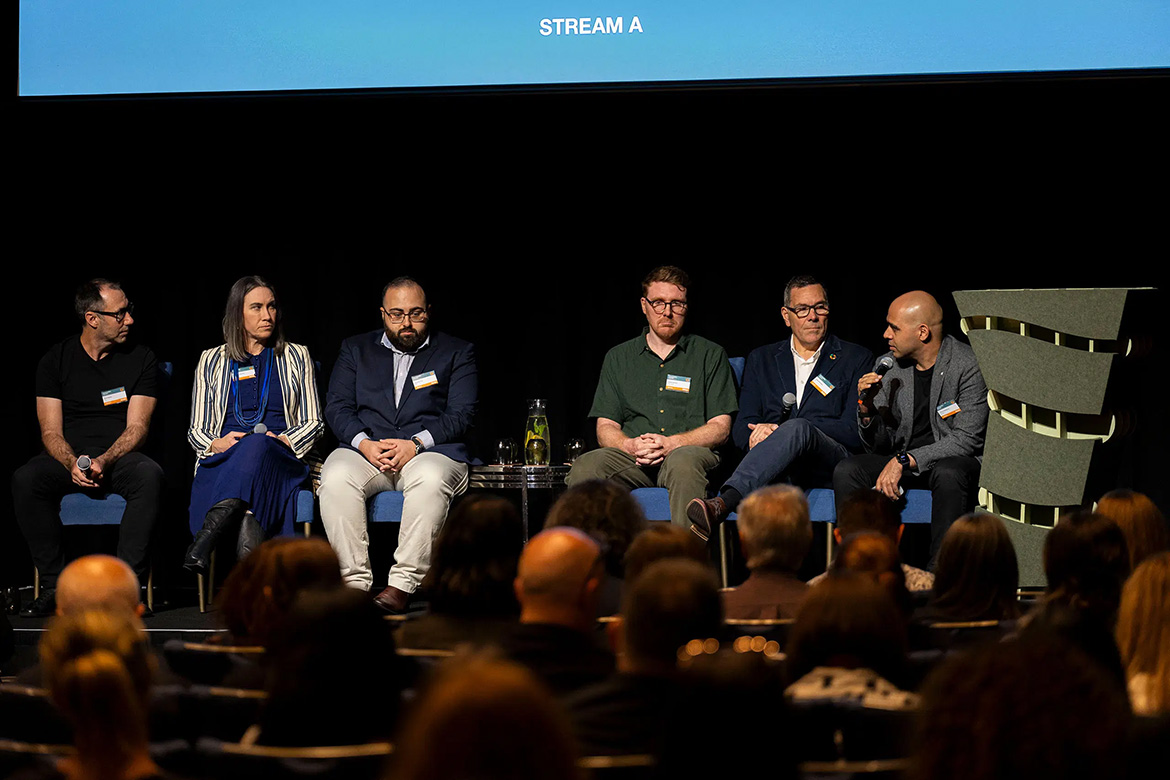
At the 2025 Sustainability Summit, a group of architects and sustainability specialists discussed how artificial intelligence (AI) is reshaping sustainability across the design, construction and operation of buildings, and where its greatest impacts may yet emerge. Moderated by Farbod Fathalipouri, Associate Director – Design Technology and Innovation, GroupGSA, the panel featured Julian Sutherland, Head of the Sustainable Assets team at JLL, Jordan Mathers, Associate Urban Designer & Innovation Leader, SJB Architects, Chris Serrano, Principal Environmental Consultant, ARUP, Dr Donna Wheatley, Partner, Gray Puksand, and Dave Pigram, Associate Professor, UTS.
From big numbers to big impact
The built environment sits at the centre of the global sustainability challenge. Moderator Farbod Fathalipouri opened the session with some hard numbers on the scale of the problem: 40% of primary energy use, 38% of global greenhouse gas emission, 12% of potable water use, 40% of global material use, and 30-40% of global waste. The alarming figures that highlight the enormous environmental footprint of the building industry also present an equally significant opportunity to drive change.
So, is AI moving the needle on sustainability in the built environment?
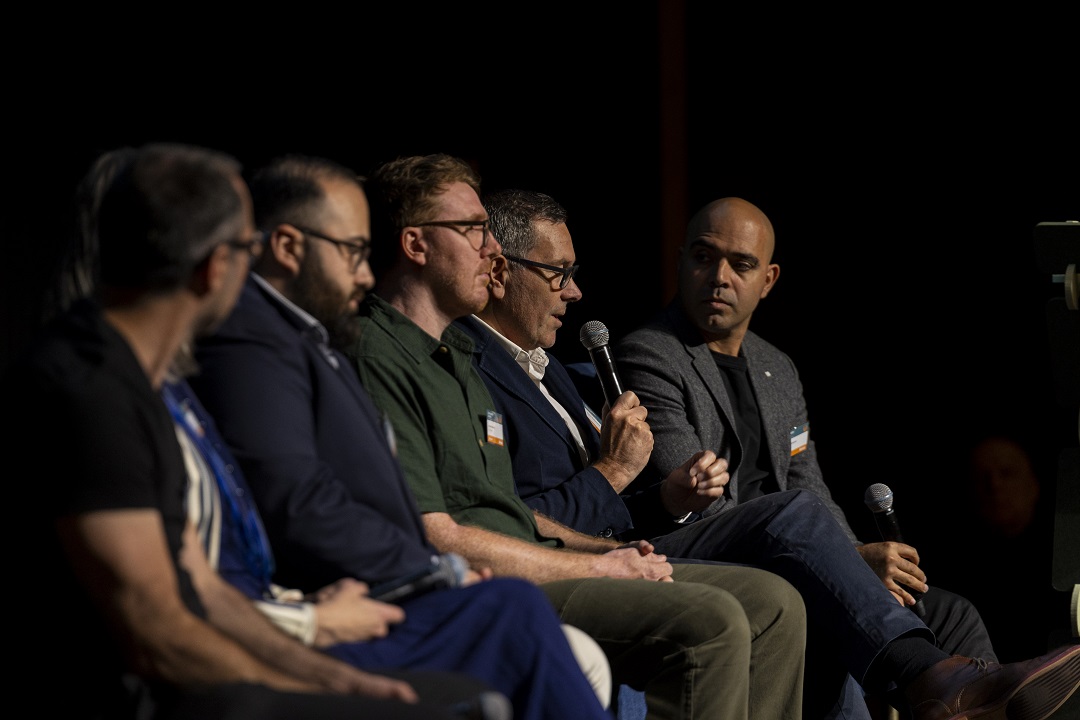
Speaking from the perspective of his work with computational design, evolutionary algorithms and optimisation systems as against the more contemporary large language models, UTS Associate Professor Dave Pigram elaborates on how “old school AI” has been quietly delivering measurable sustainability gains for years, specifically mentioning projects that demonstrate AI’s capacity to radically reduce energy use and embodied carbon.
The first one is an adaptive lighting system in which each light fixture contains a sensor that communicates with others to negotiate appropriate lighting levels based on occupancy. Without needing traditional commissioning, the system self-adjusts in real time, achieving energy savings of around 70 per cent while improving occupant experience.
In a very different application, Pigram describes a patented design system for offshore floating wind turbine platforms, which uses topological optimisation to minimise material use while maintaining stability and structural integrity. The outcome is a reduction in material and transport costs, and a lower levelised cost of energy – both critical for scaling renewable infrastructure.
Yet another project involves an innovative air-conditioning duct system that is robotically 3D printed from recycled plastic and delivers up to 89% reduction in embodied carbon.
Across such projects, Pigram notes, reductions of 70-90% in embodied carbon are increasingly achievable against climate targets that demand 95% to stay on track.
AI’s role in a sustainable built environment
JLL’s Julian Sutherland argues that AI is influencing every stage across the lifecycle of buildings. Property, he points out, is a data-rich sector, encompassing everything from leases to energy use and carbon performance. AI’s power lies in its ability to interrogate these vast datasets and support more robust, evidence-based decisions.
AI is also informing investment decisions right from the very beginning: whether a new asset is needed at all, where it should be located, and how changing use patterns such as hybrid work influence demand. Even before design begins, AI-driven analysis can shape briefs by evaluating whether refurbishment or adaptive reuse might outperform new construction in carbon terms.
In repositioning older assets, Sutherland says, AI enables granular insights into how people actually use buildings and surrounding spaces, tracking movement patterns, access points and connections to transport and amenities. These insights can fundamentally reshape how existing buildings are reimagined, repositioned and reset within evolving urban contexts.
In terms of design outcomes, AI-enabled tools are now analysing the structural frames of these buildings to optimise facades, daylight, energy, heating and cooling. Crucially, he notes, AI accelerates access to best practice, helping teams benchmark designs against industry-leading standards and explore more ambitious outcomes.
Even during the operational phase of the building, AI-powered analytics are helping deliver significant performance gains by simply analysing building systems and identifying inefficiencies.
However, at the end of the day, AI outcomes depend on the quality of data. Thanks to BIM systems, Sutherland says it’s possible to access information about the building, underlining the importance of having the right, consistent, data for decision-making.
AI in design: Optimisation and materialisation strategies
“A lot of the optimisation work is to know genuinely the constraints and opportunities of the materialisation strategy,” says Pigram. By embedding fabrication constraints directly into optimisation processes, designers can ensure that generated forms are buildable, avoiding the waste and compromise of post-rationalisation.
Using genetic algorithms, for instance, thousands of design iterations can be evaluated against multiple criteria, with embodied carbon increasingly the primary objective. The ability to place material only where it is structurally needed underpins the radical gains being achieved.
Pigram also suggests that such open-ended, customisable materialisation systems, where one can link design intent to built outcomes, also enable richer engagement with culture, connecting with Country, storytelling and place.
Large language models in practice
Unlike the controlled environment, clean data from early AI, large language models (LLMs) – such as ChatGPT – which are increasingly being used in design practices, operate on messy data, making verification and reliability key concerns, says Dr Donna Wheatley from Gray Puksand.
While AI tools are proving highly efficient for research, communication, writing and image generation, Wheatley stresses the need for making the right judgement call on outputs based on domain knowledge, given the constraints of NDAs and proprietary information that limit what data can be shared.
“It is getting better and better, but we’re always going to be challenged by some of these barriers to getting the information,” she adds.
Barriers to AI adoption in design: Leadership, trust and ethics
SJB’s Jordan Mathers points to lack of leadership and proper implementation plans in practice as “the biggest barrier”, with research indicating that the vast majority of generative AI pilots, particularly in enterprise environments, fail due to inadequate training and poor uptake by employees, often driven by fear that AI will replace their jobs.
The leadership must clearly position AI as an augmentative tool rather than a substitute for human creativity, he argues. There’s a human aspect to designing and producing buildings and the built environment that AI cannot replicate because “it doesn’t actually think creatively, it just looks like it is creative”.
“It’s up to the leaders in our practices to push forward an appropriate AI agenda, strategy, and policy about how it can and can’t be used, to be ethical, responsible, transparent, and to identify pathways and workflows in which it can improve the quality of the work that you’re doing, and not to erase you from that workflow.”
Joining the ethical debate, Chris Serrano from ARUP emphasises the need for “ethical guardrails” in the use of LLMs, particularly given the persuasive but sometimes unreliable nature of data outputs. These systems are designed to feed engagement, he says, and could result in outputs with irrelevant data sources and unverifiable claims, necessitating rigorous human oversight from an ethical perspective. Practitioners, he stresses, remain accountable for what they sign off.
Beyond the hype: AI, data centres and the environmental impact
Dr Wheatley raises a paradox at the heart of current AI adoption: Preliminary assessments suggest that, at present, the energy used to run AI models may outweigh the sustainability benefits they deliver.
As an environmental impact assessment practitioner, Serrano says data centres have large power and water requirements and the numbers are concerning. For instance, data centres, which were set up in Ireland with tax breaks, consume approximately 25% of the country’s total grid power.
“At a global scale, 1% of greenhouse gas emissions can be attributed to data centres.”
However, he also sees an opportunity for industry stakeholders to drive better outcomes in this area.
Turning best practice into normal practice with AI
Sutherland says AI can become an additional member of the team by applying all the right checks and balances to the work they do. As a sustainability professional, he believes that AI’s ability to research things, find best practice and share knowledge should be leveraged, because “it’s going to help people find out what good looks like”.
One of the biggest barriers to sustainability is getting everybody to turn best practice into normal practice, he says, and AI can help accelerate the transition.
Mathers observes that it’s important to engage with AI in a meaningful way that works towards your business – one that’s not in conflict with the business’ values and objectives.
Having a human touch is a core aspect of being a design practitioner, he says, one that allows them to have a meaningful engagement with how they deliver projects for clients and the people that use these buildings and spaces.
“Use what works for you and what works for your clients to engage with the built environment in a meaningful way. It’s about augmentation, not automation. It’s there to provide a bit of a helping hand.”
The engaging session highlighted both the promise and the paradox of AI – its potential to accelerate sustainable outcomes, and its own growing energy footprint – concluding that AI must remain a tool guided by human judgement rather than a replacement for it.
This panel was sponsored by our partners, Billi Australia and DECO Australia.
Sign up now to receive updates for the 2026 Sustainability Summit – where practitioners, thinkers, and community leaders will continue shaping the future of sustainable design.
Main image: (L-R) Dave Pigram, Dr Donna Wheatley, Chris Serrano, Jordan Mathers, Julian Sutherland and Farbod Fathalipouri
