-
9 January 2026
Part of Australia’s longest-running Sustainability Awards program, the Sustainability Summit has become an essential event for built environment professionals seeking clarity, inspiration and leadership in a rapidly changing landscape. The 2025 Summit features ten pivotal panels addressing today’s most pressing sustainability challenges, from housing and urban resilience to climate-responsive design. Designed to foster dialogue and share best practice, it offers unmatched insights for professionals shaping the future of our cities.
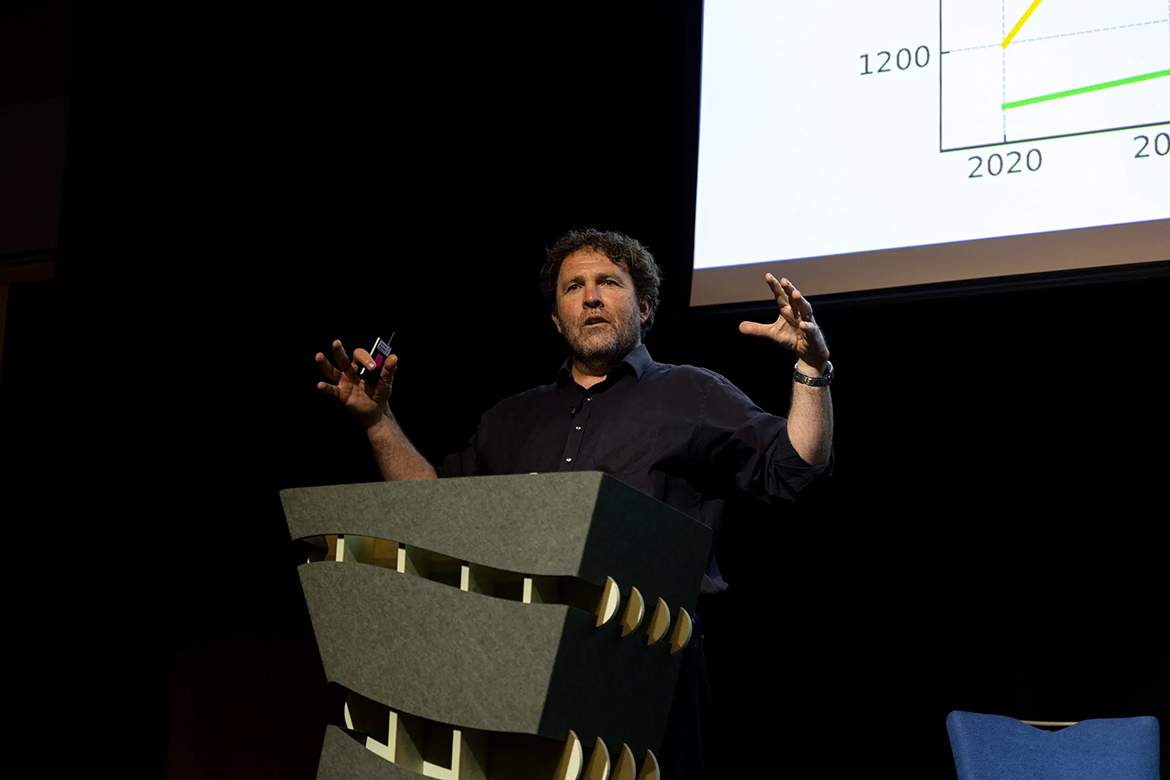
At the session titled ‘Electrifying everything under the Sun’, inventor, author, engineer, entrepreneur and energy expert Saul Griffith argues that electrification is the key to cutting emissions, lowering energy bills, future-proofing Australian homes, and driving the country’s journey to decarbonisation. Using hard data, lived examples and anecdotes, he explains why all-electric living is inevitable, affordable and urgent in Australia.
Griffith has spent much of the last decade trying to answer one deceptively simple question: How do we decarbonise an entire economy – fast? His books chart that journey, beginning with Electrify in 2019, which was written as a policy manual for the United States, influencing elements of the Biden administration’s climate platform. The Big Switch translated the same decarbonisation ideas for Australian thought leaders, while The Wires That Bind focuses on the economic benefits of electrification for Australian communities. His most recent book, Plug In, is written mainly for tradespeople as a useful handbook to guide the electrification journey to clean energy.
Mapping the energy flow: Making a case for an all-electric Australia
Griffith recalls how, in 2018, he helped map every energy flow throughout the US economy to advise the US Department of Energy on decarbonisation by tracking how petroleum, nuclear, renewables, coal and natural gas move through the different sectors, from industry and transportation to homes and commerce. The findings were quite revealing: The United States needs 101 quads of energy but could potentially run the same economy on just 43 quads with electrification (1 quad = 1 quadrillion British thermal units).
Electric processes are really efficient, he explains, unlike burning coal or gas where about half of the energy is lost in making electricity. By implication, this means decarbonisation is not just about replacing fossil fuel and coal with renewables; it’s also about needing considerably less energy overall.
“That’s just the raw efficiency of electric machines as opposed to burning fossil fuels. That’s why an electric car uses about a quarter of the energy per kilometre compared to a petrol car,” he observes.
For more than 50 years, efficiency has been prioritised in the design and building of homes in terms of using insulation, sealing cracks and double-glazing windows. However, economically, the numbers are stacked in favour of complete electrification.
To make his point, Griffith tells the story of his friend Fred, a North Sydney resident with three kids, two electric vehicles and a swimming pool. Data from his fully electrified house over three years reveals that his rooftop solar system produces 141% of his household’s total energy needs, including transport, making him a net exporter of 41% of his energy.
The payoff is not abstract – Fred saves about $8,000 a year on energy alone by electrifying everything in his life. Conversely, the average Australian household pays for three ‘energy subscriptions’ – petrol, gas and electricity. Through electrification, a single subscription can do it all and do it cheaper, saving a lot of money, Griffith says, as he lays out a strategy that could eliminate most household emissions by 2040.
The five decisions to a zero emission home
At the household level, these five choices made over the next 15 years can get the home to zero emissions by 2040:
1. Electrify hot water
2. Electrify space heating and cooling
3. Electrify cooking
4. Electrify vehicles
5. Buy zero-emissions electricity
Even small businesses, Griffith says, can adopt the same strategy to decarbonise. Between the domestic and commercial sectors, these five decisions can help get rid of 70-75% of emissions in Australia, or anywhere in the world.
Electrification saves money, he reiterates. Comprehensive modelling of energy use shows that a typical Australian household, by going all electric, spends less over the lifetime of appliances and vehicles, even with increased electricity consumption from the grid and even before adding rooftop solar. With solar, the savings increase dramatically; with a battery, even more.
“If every Australian household did this by 2040, we would save $1 trillion – money that could go into public education,” he says. “The only way for Australia to hit its emissions target is if every single purchase of anything over the next 15-20 years doesn’t burn fossil fuels.”
Bringing another angle to the conversation, Griffith says that electrification is inflation-proof – it’s a shift from fuels to finance. Instead of buying cheap machines and feeding it expensive fuel, one can buy a slightly more expensive machine and feed it cheap solar energy generated by a system bought on a fixed interest rate that won’t be impacted by future volatility from global conflicts.
“It’s anti-inflationary in a genuine economic sense,” he says.
The bigger picture: Land and the built environment
Griffith widens the lens to the physical scale and impact of human activity on Earth. Humanity has now built or moved around 1.2 trillion tonnes of material, roughly the combined mass of all animals. At 1.5 billion in number, cars alone outweigh all wild mammals by a factor of 325.
Housing is a major part of this story. An average Australian two-storey brick veneer home of about 230 square metres weighs around 160 tonnes and would have taken between 220,000-440,000 kWh to construct, equivalent to energy consumption in an average home over 50 years at 15kWh/day.
That’s a huge amount of energy embodied in a single building, which when extrapolated across all housing adds to the emissions load on the planet, strengthening the argument for an all-electric Australia.
This panel was sponsored by our partners, Alspec and Stormtech.
Sign up now to receive updates for the 2026 Sustainability Summit – where practitioners, thinkers, and community leaders will continue shaping the future of sustainable design.
Main image: Saul Griffith
