-
9 January 2026
Since its inception, the Sustainability Summit has served as a catalyst for transformative conversations about environmental responsibility and innovation in the built environment. With a diverse line-up of industry leaders, academics, designers, policymakers and environmental advocates, the Summit creates a collaborative space for exchanging ideas, accelerating positive change and encouraging holistic, community-led approaches to building a more sustainable future.
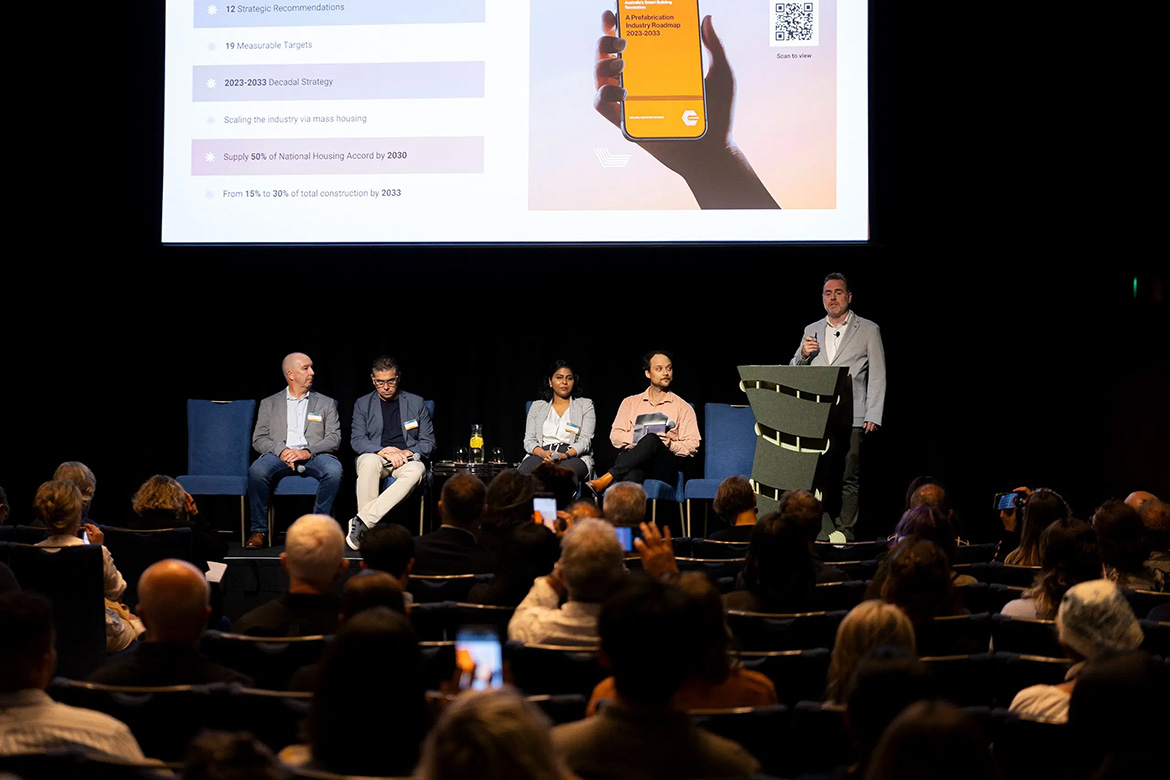
During the panel discussion on Modern Methods of Construction (MMC), practitioners from across design, manufacturing and construction cut through the hype to examine where prefabrication, modular construction and Design for Manufacture and Assembly (DfMA) are genuinely delivering, and where systemic barriers still act as roadblocks, as they provide a nuanced perspective on the impact of these solutions on the building industry.
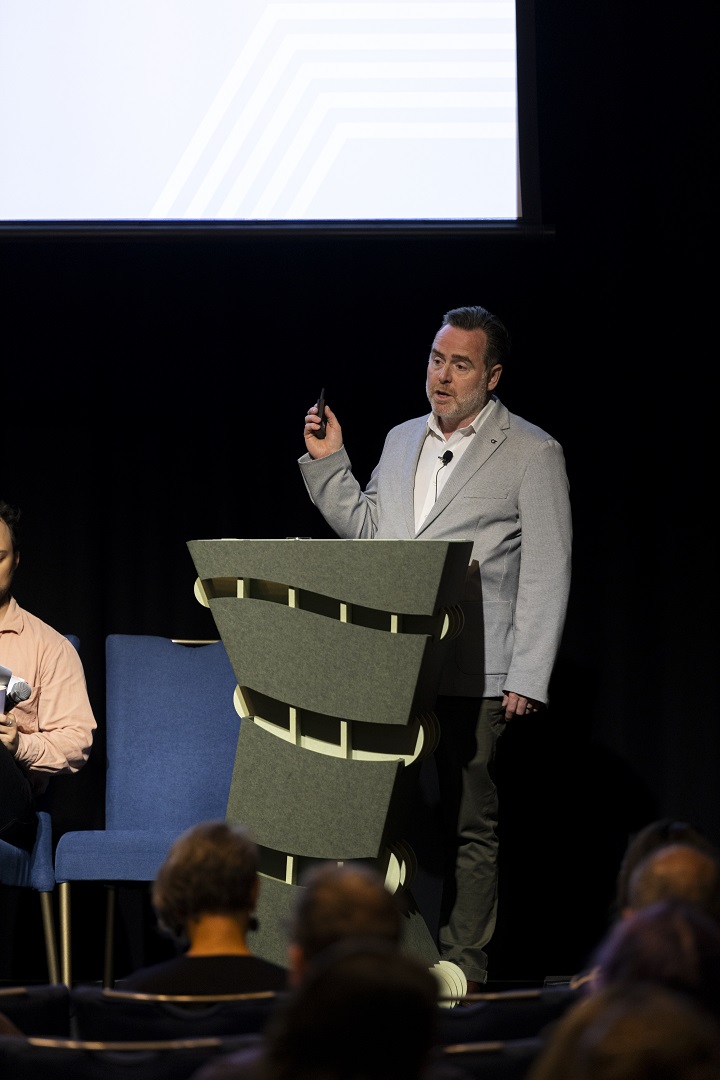
Damien Crough, Co-founder and Executive Chairman of peak industry body for offsite construction, prefabAUS, opened the session with a short presentation to provide some background and context to the topic. Crough’s journey in the ‘smart building’ sector began in 2007, when he collaborated with architect Nonda Katsalidis to develop a unitised building system, which was used to construct buildings in partnership with Hickory Group. To ensure representation and advocacy for the emerging industry, prefabAUS was formed as a non-profit association with the primary aim to educate and build knowledge and expertise around MMC.
Contrary to popular perception, prefabrication helps deliver beautiful, architecturally designed buildings across education, healthcare, infrastructure and residential housing. In 2023, prefabAUS released a 10-year plan for the industry, which shows a roadmap for growing the prefabricated and offsite construction industry in Australia, and sheds light on benefits around circular economy, sustainability, and net zero, amongst others.
Over the past two years, five of the 12 recommendations in the plan have been embedded in policy at state and federal levels around Australia. The Federal Government has announced $50 million to support existing MMC programs predominantly across Victoria, New South Wales and Queensland, as well as $4 million for the Australian Building Codes Board to develop a voluntary certification scheme. The CBA has also changed their funding model, allowing up to 80% of the contract value to be funded before a house leaves the factory for the site – up from 5% previously.
According to Crough, three things are holding back the prefab industry: planning, regulation and funding, all stemming from the fact that the whole built environment is based on building things on-site, as against building them in a factory. This has to change and it is changing, he says, through multiple initiatives including funded research programs, workshops on decarbonising housing, and creating a value chain starting with design and planning. Though there is a long way to go, there is also huge opportunity with 80% of buildings expected to be built in factories in the future, he concludes.
Building faster, smarter and greener
Opening the discussion, moderator Timothy Alouani-Roby, Editor, Indesignlive & Habitus Living, asks: Where have modern construction methods truly delivered on the promise of being faster, smarter, and greener?
Challenging the idea that Modern Methods of Construction is a recent construct, Wayne Larsen, Senior Executive at PT Blink says that the Empire State Building, which was delivered with prefabricated steel and curtain walls still remains the fastest skyscraper ever built. Moving to more recent examples of multi-storey volumetric buildings being built in China in less than three weeks, he says these developments are a good showcase for what’s possible with MMC in terms of addressing issues such as time, site complexity and construction capacity. The digital design approach also optimises material use and eliminates waste, reducing the amount of construction demolition waste going to landfill – environmental outcomes that traditional construction struggles to match.
For GroupGSA Associate Principal Noura Thaha, prefabrication is not a single solution. “It’s actually multiple solutions tied together, and you just need to pick and choose the one that suits your project,” she says.
Sharing examples of multiple projects completed by GroupGSA using both approaches – volumetric buildings fully finished in factories and delivered on-site as well as kit of parts, she says that the suitability of each method depends on the project’s typology, site and location.
For NSW Police, the firm delivered nine volumetric buildings, fully fabricated in the factory and delivered on-site at multiple regional locations, with the entire construction taking eight weeks and another week to install them and get the police stations ready for occupation.
“That’s the best example of how well a volumetric design can function, especially for regional areas, because you’re bypassing issues like the availability of trades and transportation,” Thaha says.
For School Infrastructure NSW, they used both methodologies – volumetric and kit of parts – based on the typology of the buildings. An important lesson learnt during the execution of the volumetric building was the need to factor in the logistics as well as holding cost of larger modules when designing large-scale buildings like schools.
Education, healthcare and the big opportunity in housing
With so many different materials, techniques, systems, and approaches to designing and building using Modern Methods of Construction, working with a design team that understands that is really important, Crough emphasises. “The process is really different because it is so design-heavy. Everything has to be done upfront.”
Unlike traditional construction that allows work to start even without complete documentation or procurement and building strategies, prefabrication needs everything done upfront and brought to a design freeze before manufacturing can begin.
As for application, MMC is currently being used widely in education buildings in Australia, with prefabrication being a preferred option in many schools because it allows them to drop volumetric buildings during school breaks and complete them in a couple of weeks, just in time for the students to return and start using them.
Prefabrication is also gaining strong traction in healthcare, unlocking multiple benefits including speedy delivery, reduced site disruption and higher quality. Crough says residential construction – houses and apartments – has the smallest penetration of MMC; however, it also has the highest opportunity, backed by a mature supply chain of nearly 1,200 prefab-related companies. But it also needs a culture shift at the fundamental level to overcome perception issues.
Presenting a builder’s perspective, Mick Paterson, Construction Manager, Pre-Construction and Systems Development at passive house builder Blaise Building Services, underlines the need for early engagement with every stakeholder in the pre-construction process. This leads to project success because the responsibilities are fixed, the work is finalised, and all the problems are resolved ahead of time.

Barriers to MMC adoption: Practical fixes to unlock progress
“Fundamentally, the biggest challenge has always been the funding,” says Crough. Traditional lending models, designed around on-site construction do not support anything built in a factory. Until recently, banks would release only 5% of the total cost of the prefabricated building, leaving the manufacturer to cover the remaining cost until the building was delivered to the site.
Recent changes such as revised lending policies from major banks and new standard form contracts are beginning to shift the landscape for factory-built houses.
From a design perspective, Thaha highlighted fragmented regulations and approval processes as a major source of uncertainty. Regulations vary from state to state and even council to council, with every department looking at the process differently. Even the BCA code adaptation varies from state to state, she says – a solution that is fully compliant is one state cannot be implemented in another. There’s also a lack of acknowledgement about the prefabrication system in these codes and regulations, leaving the designers or engineers to interpret and design to them.
“With these risks, every project might turn into something else by the end of the approval process,” she adds. All the uncertainties and risks are added as a cost onto the prefab solution, creating risk aversion among builders and developers and diminishing all the benefits and efficiencies of a prefab system.
Still, there are encouraging signs of change in the industry including government-backed funding and innovation as well as ABCB’s guidance on prefabrication and the proposed building reforms.
While banks are revising funding rules for factory-built homes, these changes only benefit the full volumetric, single factory supply situation, and not the kit of parts sector where multiple manufacturers are involved, which represents a different kind of challenge, observes Larsen.
His solution? Productisation. By effectively productising the various components of prefab, one can validate the product, transfer title, use it as security and get it paid for offsite. “Using the product itself to secure financing offsite is the way that we’ve been addressing that challenge.”
Australia’s vast geography and sparse population represent another big challenge for MMC because building a volumetric factory, which is hugely capital intensive, would make it limited by location and unviable financially. The existing capacity of prefab manufacturers can be tapped to manufacture kits of parts, transport them, and get the products to site efficiently, reducing the overheads burden that exists in the market, Larsen adds.
DfMA: The rise of true collaboration
As the conversation shifts to DfMA, collaboration between architects, builders and manufacturers emerges as the defining shift over the past decade.
Collaboration, says Paterson, is a critical part of the prefab process, particularly in the pre-construction phase. By getting everyone around the table at the very beginning and solving all the problems early on in the process, there will be less time on the site and less number of people involved with more opportunities for using recycled materials and recycling on-site. The process is better aligned with achieving the desired sustainable outcomes by choosing prefab companies that can support those goals.
Australia’s construction workforce crisis and the factory advantage
Broadening the conversation, Larsen says that moving into manufacturing presents a great opportunity to open the building industry to a whole new cohort of workers who don’t want to work on a construction site. Factory-based construction allows workers to operate in accessible and flexible conditions, and out of the weather. Also, moving into a manufacturing world will liberate the construction industry to focus on building roads, bridges, tunnels and other infrastructure that can’t be done in factories. Manufacturing buildings in factories also allows better control on quality and waste management. “it changes the way that we build for the better.”
MMC, design standardisation and the rise of the super tradie
Standardisation, says Thaha, is at the heart of Modern Methods of Construction because it helps to achieve repeatability and certainty in design. MMC also makes room for Early Contractor Engagement and sorting the transportation impact in procurement. Then, there’s the use of technology to create federated designs. All of these benefits translate to limited time spent on-site trying to resolve issues.
Acknowledging the increasing productisation of building components and elements, Crough says DfMA allows for the greatest opportunity to get to circular economy and net zero. “If we are designing buildings to be manufactured and assembled, we’re designing them to be disassembled, reused, and recycled. This is a real shift that’s happening.”
This is also leading to the development of a hybrid skill base of trades who have the skills to perform traditional functions but also have manufacturing skills, knowledge and expertise as the industry moves towards industrialised construction. The future, he reiterates, will be one where 80% of buildings will be built in factories, therefore, a focus on education, skill building, and digital tools will create the “super tradie” who knows how to build buildings and also put together prefab buildings.
This panel was sponsored by our partners, Network Architectural and Cosentino.
Sign up now to receive updates for the 2026 Sustainability Summit – where practitioners, thinkers, and community leaders will continue shaping the future of sustainable design.
Main image: (L-R) Mick Paterson, Wayne Larsen, Noura Thaha, Damien Crough and Timothy Alouani-Roby
