-
9 January 2026
The annual Sustainability Summit unites Australia’s leading voices in sustainable architecture and design for a full day of learning, discussion and connection. Featuring expert-led sessions, panels and networking, the Summit equips built environment professionals with insights, CPD points and inspiration to shape a greener, more resilient future.
Inside the debate redefining Australia’s housing crisis
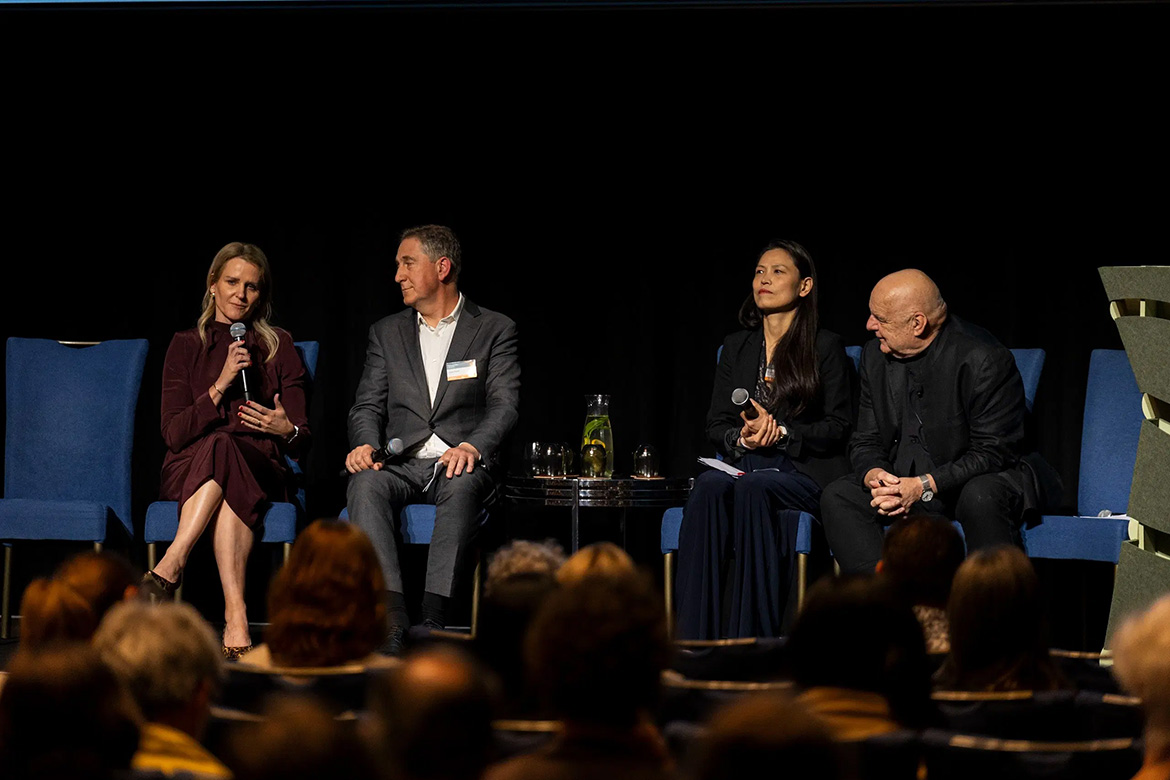
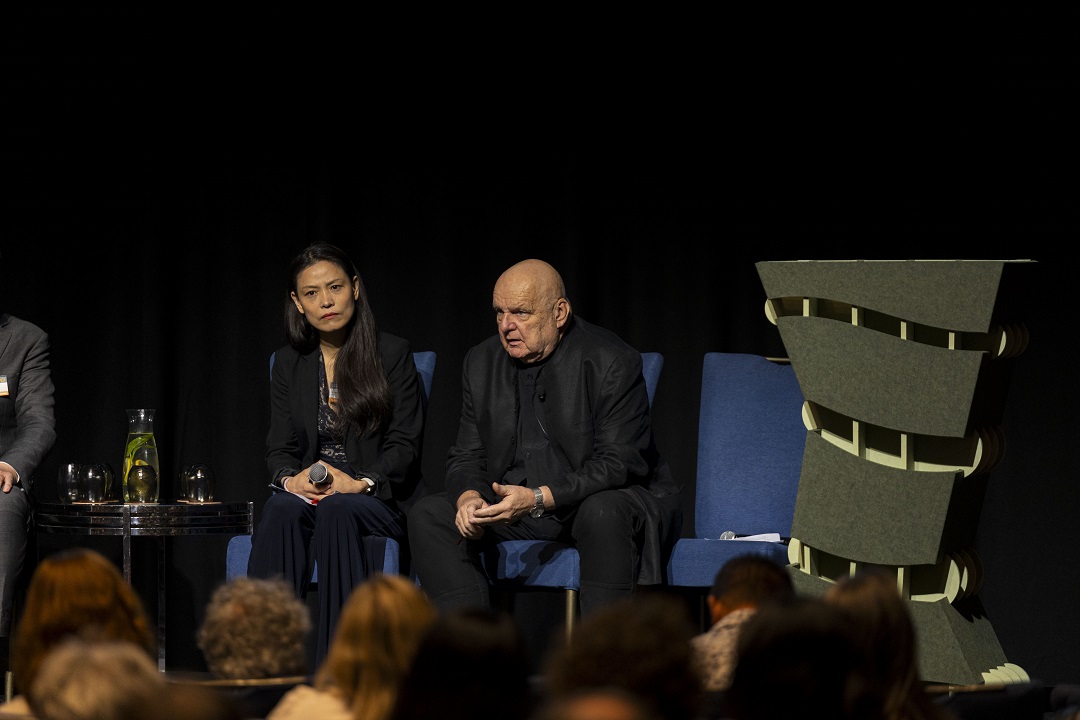
Australia’s housing crisis is not just about building more homes. This panel discussion explores why finance, planning, social housing policy, density and cultural expectations must align to address a deeply interconnected housing system. Moderated by Tone Wheeler, Principal, Environa Studio, the panel features Nerida Conisbee, Chief Economist, Ray White, Dr Julie T. Miao, Associate Dean, Associate Professor in Property and Economic Development, University of Melbourne, and James Pearce, Partner, FK.
The conversation opens with a deceptively simple question: What is the housing crisis problem?
For Dr Julie T. Miao, the problem begins with the definition itself. Across government departments and institutions, the term is measured differently, producing fragmented responses that address only parts of the problem. However, from an academic’s perspective, she equates the housing crisis to the inability to build the right types of housing in places where people want to live and can also afford to live. This mismatch between supply, demand, affordability and location is what defines the housing crisis, she says.
Rethinking ownership, apartments and renting for life
FK’s James Pearce agrees that the housing crisis is a supply problem but challenges the perception that planning processes are the bottleneck. Projects typically stall during cost estimation when the feasibility aspect comes into play. However, he says, architects can provide design solutions for housing that make it more affordable to build.
Pushing the conversation further, he also questions why housing is considered as a wealth creation mechanism, rather than something that’s required. If housing continues to be treated as an investment asset, affordability will always be compromised.
To change this status quo, Australia must move away from its fixation with “a home on a block of land” to apartments, which, Pearce says, is already happening with people recognising the advantages of apartment living including amenity and community. The build-to-rent concept is also gaining ground and long-term renting, not ownership, could be the next solution to resolving the housing crisis, addressing both density and supply.
Escalating building costs, big homes and demographic realities
Affordability, says economist Nerida Conisbee, is the most visible aspect of the housing crisis, with people unable to buy or rent within their means. While affordable housing is available, they are in locations where people don’t want to live, such as Melbourne CBD, for instance, which has a number of really cheap apartments but not many takers.
House construction costs have also escalated drastically in recent years, going up by 30-40%, depending on the location, making it near impossible to even build at replacement cost. In many areas, particularly on the urban fringe of most capital cities, it is now cheaper to buy a home built several years ago than to construct a new one.
Perhaps most critically, Australians want cheap homes, but don’t want to live in cheap homes. Besides, large houses with multiple bedrooms remain the dominant aspiration, even as household sizes shrink and single-person households grow. The result is a housing stock increasingly misaligned with demographic reality.
“We don’t want to live in the types of homes that could be built affordably long-term,” Conisbee observes.
Property industry or housing industry?
Part of the problem, says architect Tone Wheeler, is that Australia has a property industry, not a housing industry. Interestingly, there are 11 million homes, and only 10 million households in the country, which means a significant number of these homes are perhaps holiday houses, with many off the market. However, fewer than half of Australians live in a home that truly suits their needs.
For Wheeler, the deepest crisis lies not in market housing, but in social housing. Once comprising around 7% of national housing stock, social housing has fallen to roughly 3%, despite an estimated 10% of the population needing it. Drawing a sharp distinction between affordable housing, which is priced relative to market value, and social housing, which is tied to household income, he argues that conflating the two has muddled policy responses.
Can the private sector help deliver social outcomes?
“Is social housing really dependent on government funding?” asks Pearce.
Sharing a case study of an apartment project done for the Barnett Foundation, he recalls that it had an interesting model that could offer a pathway for private developers to enter the social housing space. By saving costs on marketing and agents’ fees, and constructing a cost-effective building, the organisation was able to sell the 30 apartments to existing social housing tenants living in the neighbourhood at 30% less than the market cost of the area.
People living in social housing, who have jobs in the area, are unable to move out because they can’t afford alternative accommodation in the same area. The idea that social housing could be developed on land that’s secured at a lower cost and is located in inner-city, not necessarily prime locations, and sold at less than market cost to social housing tenants, has a major upside. It takes people out of social housing, enabling others on the waiting list to get in, thereby, keeping the whole system moving.
“One of the challenges with social housing is getting scale,” comments Conisbee, citing Pearce’s example. While many social housing projects succeed, the scale of the problem is challenging, given that thousands and thousands more are needed. She also questions the government’s priorities in incentivising first-home buyers, regardless of their income, when the housing policy should be fundamentally focusing on social housing.
The funding gap at the heart of social housing
For Dr Miao, the primary challenge is financial. Construction costs are broadly similar regardless of whether the housing is social, affordable or market. What differs dramatically is the rental income – in social housing, rents tied to tenant income simply cannot cover development costs, raising the question of financial viability of social housing projects.
This gap, she says, needs to be narrowed down, which is where the government has to step in, providing support, for instance, through land partnerships.
Wheeler takes the argument further, pointing to the role of financial institutions. In a country where a third of households are effectively paying someone else’s mortgage by renting, he questions why rental payments cannot be converted into pathways to home ownership.
The housing gap doesn’t have an architectural solution, he reflects. It needs a financial solution for people to be able to afford their house.
Build-to-rent: Promise, limits and scale
Is long-term rental a solution to Australia’s housing crisis?
Conisbee acknowledges the value of build-to-rent as a potential solution for Australia’s renter population, especially for people who do not want to or cannot immediately buy a home. However, she cautions that the majority of build-to-rent projects are renting at a premium, and the renter is most likely to pay more than market rent for that suburb, which works at cross-purposes to housing affordability. Also, build-to-rent housing accounts for a miniscule percentage of total rental stock.
Internationally, Conisbee says, the rental markets in the US are dominated by institutional investors, crowding out individual home buyers. This could happen to Australia in the future, she warns, if build-to-rent or institutional capital becomes very prominent in owning homes, making the whole affordability challenge even more problematic in terms of its scale.

Density, high-rise and the missing middle
The discussion turns to density and whether high-rise living is a good solution for Australia, which has a strong tradition of horizontal suburbia.
Dr Miao suggests that while high-rise towers are already accepted in CBDs, a better model lies in mid-rise six to eight storeyed buildings in well-connected and well-serviced neighbourhoods.
Observing that Australia doesn’t really have very dense cities, Pearce says inner suburbs present an amazing opportunity for greater density.
This ‘missing middle’ emerges as a recurring theme in the housing conversation, a typology that sits between detached houses and high-rise towers that could provide density without overwhelming communities. It’s a solution that represents an alternative to high-density projects in middle suburbs, which face resistance from local residents because they don’t want chaotic traffic.
There is demand for this densification, says Conisbee, from older people wanting to downsize from their large homes.
Taking the local community into confidence when developing in suburban neighbourhoods can effectively address any resistance to densification, says Pearce. During a project in Hampton, which was being built on three standard house sites, the developer and architects personally interacted with residents in the neighbourhood, sharing the designs and communicating their plans. This community consultation resulted in zero objections from the neighbours when the plans were lodged – offering a solution to managing density in sensitive residential areas.
The three-storey walk-up: Why it matters in today’s context
Wheeler champions the humble three-storey walk-up as an overlooked solution. These buildings sit comfortably within suburban contexts, avoid costly fire and services requirements, and can be built by trades accustomed to house construction rather than complex towers. Incremental density, he argues, makes better use of existing infrastructure such as shops, schools and services, without the rupture caused by large high-rise developments.
This is already happening on the Gold Coast, says Conisbee, where they are considering smaller blocks for development to avoid overwhelming the neighbourhood suddenly, which a high-rise could do. People don’t have a problem with density, she adds. They just don’t want it to be that scale.
Making a case for mid-rise developments, she adds that funding is a major problem for big towers, with investors and homeowners unwilling to buy into a project before it’s built, whereas getting people interested in a lower-scale project with a limited number of apartments is a lot easier.
Modern Methods of Construction and Australia’s risk aversion
That it takes more people now to produce the same amount of GFA than it did five decades ago strongly supports the case for Modern Methods of Construction (MMC) such as prefabrication and modular solutions, says Pearce. However, while factory-built building structures do deliver speed, quality and safety, the cost remains a barrier.
Conisbee says MMC is beginning to take off in Australia, not only with government support but also by the entry of companies using robotic technology to build homes. Modular construction also offers a quick solution for building in regional and remote areas where access to labour remains a problem.
Cultural risk aversion is one of the reasons behind Australia’s relatively slow adoption of prefab. Interacting with policymakers and industry stakeholders during a study of innovation districts, Dr Miao found that Australia preferred to let other markets test innovations before adopting them locally.
Yet without greater innovation, productivity in construction will continue to stagnate, undermining affordability gains in housing supply.
This panel was sponsored by our partners, WoodSolutions and James Hardie.
Sign up now to receive updates for the 2026 Sustainability Summit – where practitioners, thinkers, and community leaders will continue shaping the future of sustainable design.
Main image: (L-R) Nerida Conisbee, James Pearce, Dr Julie T. Miao, Tone Wheeler
