-
26 June 2026
Alexander Symes Architect principal Alex Symes reflects on winning the Architecture & Design Sustainability Awards, most recently in the 2024 Commercial Architecture (Small) category— and what the discipline owes the next generation of climate-focused designers.
Sydney-based practice Alexander Symes Architect has built a reputation on the proposition that good design and sustainable design are inseparable. Following the practice’s recognition at the Architecture & Design Sustainability Awards, principal Alex Symes reflects on what that win has meant for the work — and what the discipline owes the next generation of designers now confronting the realities of climate change.
A platform for a different conversation
For Symes, recognition through the Architecture & Design Sustainability Awards did not redirect the practice so much as amplify it. Sustainability had already been a central concern — not as a compliance layer applied to finished architecture, but as a driver of form, material, and spatial thinking from the outset. The award gave that position a louder voice.
“The award did not change the direction of the work so much as amplify it,” says Symes, “allowing for more confident and transparent discussions about trade-offs, long-term value, and environmental responsibility.”
In practical terms, the recognition shifted conversations with clients and collaborators away from tick-box approaches toward what Symes describes as a more rigorous, performance-led methodology grounded in lifecycle thinking. It also provided a level of validation that made it easier to advocate for decisions that can initially appear unconventional — prioritising adaptive reuse over new construction, or specifying materials based on embodied carbon rather than purely aesthetic criteria. Rather than treating sustainability as a constraint, the award reinforced it as a framework for innovation.
Impact beyond the project boundary
The award-winning project’s influence has extended well beyond its site. From an environmental perspective, its emphasis on adaptive reuse and low-embodied-carbon materials continues to demonstrate a point that Symes considers fundamental: that retaining and reworking existing structures is not a compromise on spatial quality or architectural ambition. The carbon savings are real and the outcomes can be compelling.
Socially, the project has contributed to a broader awareness of how sustainability can be embedded in everyday environments. By making environmental strategies legible — through material expression, passive design, and spatial organisation — it brings occupants into a more direct relationship with climate-responsive architecture. That visibility matters. It shifts sustainability from an abstract concept into something tangible and experiential.
“Its impact is cumulative,” Symes notes. “It continues to influence both how similar projects are approached within the practice and how clients and the wider design community perceive the role of architecture in addressing environmental challenges.”
Data-informed, resilience-focused
Sustainability strategies at Alexander Symes Architect have become increasingly data-informed, driven by advances in digital tools that now allow for earlier and more precise evaluation of design decisions. Embodied carbon analysis and operational performance modelling, in particular, have shifted sustainability from a largely qualitative aspiration to a quantifiable aspect of design development — enabling a more iterative, evidence-based process.
The growing availability of climate data has reinforced a parallel shift: designing for resilience, not just current conditions. Passive design strategies remain fundamental, but they are now calibrated with greater sensitivity to long-term climatic shifts, ensuring buildings are equipped to perform across their entire lifespan rather than simply meeting today’s benchmarks.
On policy, Symes acknowledges the gap between where the industry needs to be and where regulation currently sits, while remaining pragmatic about its value. Net-zero targets set clearer benchmarks and expectations — but for the practice, they function as a baseline from which to push further, particularly in reducing embodied carbon and prioritising circular material strategies. Emerging technologies are approached with similar selectivity: integrated where they meaningfully contribute to performance, but never at the expense of simplicity, durability, or long-term adaptability.
Embedding sustainability at the core
Asked what lessons might guide the next generation of designers, Symes is clear that the most important shift is conceptual. Sustainability must be embedded at the core of architectural thinking — not treated as an add-on or a specialisation. That requires understanding the carbon implications of design decisions, particularly in relation to materials and construction, as a fundamental rather than an elective competency.
Working with what already exists is equally central. Adaptive reuse, retrofit, and incremental transformation often represent the most effective pathways to reducing environmental impact — and open up more nuanced and contextually responsive forms of design, even if they challenge conventional notions of architectural progress.
Collaboration, too, is indispensable. Addressing climate challenges requires genuine engagement across disciplines — engineers, builders, policymakers, and clients — and the ability to communicate and advocate for sustainable outcomes is as important as technical knowledge.
“Climate, budget, and material limitations can drive more inventive and meaningful architecture when approached creatively,” says Symes. “The next generation has access to better tools and data than ever before, but the fundamental task remains the same: to design buildings that are not only efficient, but enduring, responsible, and deeply connected to their context.”
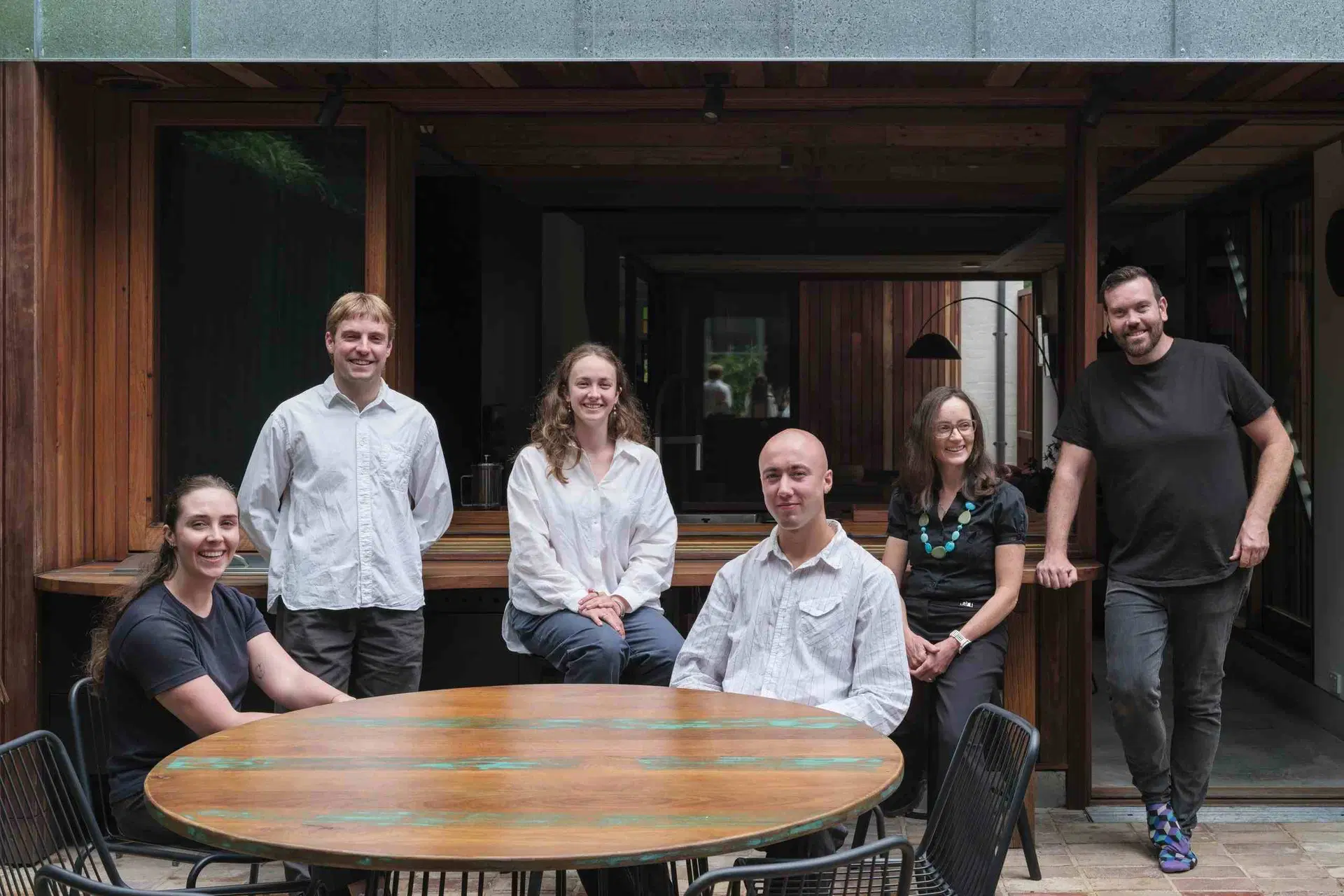
Image: Alexander Symes Architect with Alex Symes first on the right. Source: https://www.alexandersymes.com.au/
Article originally published: https://www.architectureanddesign.com.au/editorial/sustainability/alex-symes-sustainable-architecture-award-impact
About the Sustainability Awards
Celebrating its 20th anniversary in 2026, the Sustainability Awards is Australia’s longest running and most prestigious program recognising excellence in sustainable design and architecture. Entries are evaluated by an expert judging panel, with winners across multiple categories announced at the annual Sustainability Awards Gala on 12 November 2026 in Sydney. To enter or find out more, head to www.sustainablebuildingawards.com.au
