-
9 January 2026
Every year, the Sustainability Summit provides a platform for transformative conversations on environmental responsibility, innovation, and collaboration within the architecture and design industry.
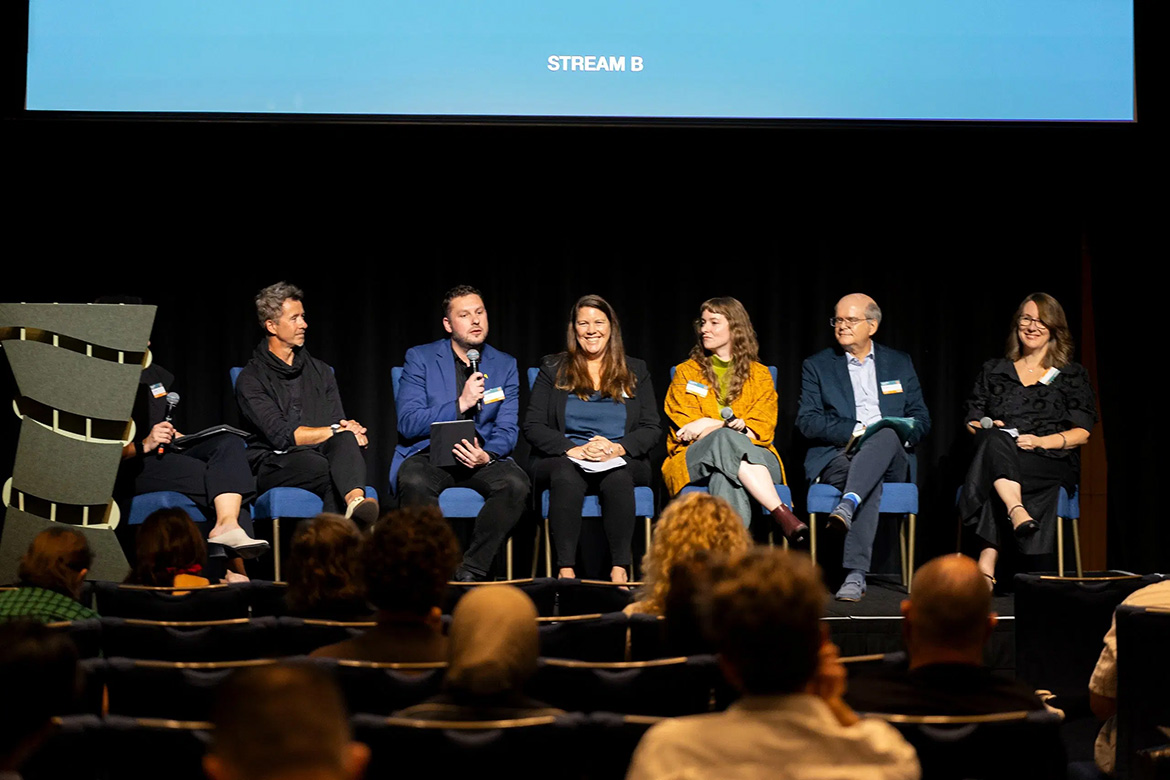
The panel discussion at the Sustainability Summit 2025, moderated by FK Principal Angela Biddle, brought together six industry stakeholders to examine how sustainability, circularity and human-centred design are influencing the future of the built environment through the lens of wellbeing. Featuring both design and sustainability professionals, the panellists included Tamara White, interior designer and Principal at Warren and Mahoney (WAM), Mark Barthel, Head of Standards and Compliance at Good Environmental Choice Australia (GECA), Aimee Munro, Senior Associate at Gray Puksand, Tara Veldman, Managing Director at Billard Leece Partnership (BLP), Jack Noonan, Senior Vice President, APAC at the International WELL Building Institute (IWBI), and Jason Gibney, founder, Jason Gibney Design Workshop (JBDW).
Designing for wellbeing
Sustainability has always been part of design for decades but the latest trends indicate a shift to the social and wellness aspects. A growing movement across the architecture and design industry is driving a deeper focus on human wellbeing in the spaces we inhabit. Sharing their expertise and experience through their projects, the panellists discuss how emerging trends from neuroinclusive design and healthier materials to real-time performance monitoring are challenging traditional approaches and reshaping everything from workspaces to hospitals.
Feeling safe in a space, says JGDW founder Jason Gibney, contributes to wellbeing. It’s all about observing how we feel in spaces and designing the space from that perspective. Feeling stressed in an environment comes from fear while the concept of wellbeing comes from being in a place where fear is absent, he explains.
BLP Managing Director Tara Veldman agrees, speaking from her own experience working on billion-dollar children’s hospitals. Stress in healthcare environments, she says, leads to bad outcomes, therefore, designing these spaces should be centred around how to make a child and their family feel safe so that the hospital stay has the actual benefit of healing.
In one of their recent projects at the Children’s Hospital in Sydney, they added a food delivery window so that families could order food and snacks any time of the day or night – a design intervention that made a massive difference to everyone’s experience of that hospital.
For the Children’s Hospital in Melbourne, they introduced a meerkat enclosure with “real meerkats” right in the middle of the consulting areas, creating a drawcard for children – who are otherwise reluctant to go to hospitals – to come here for treatment.
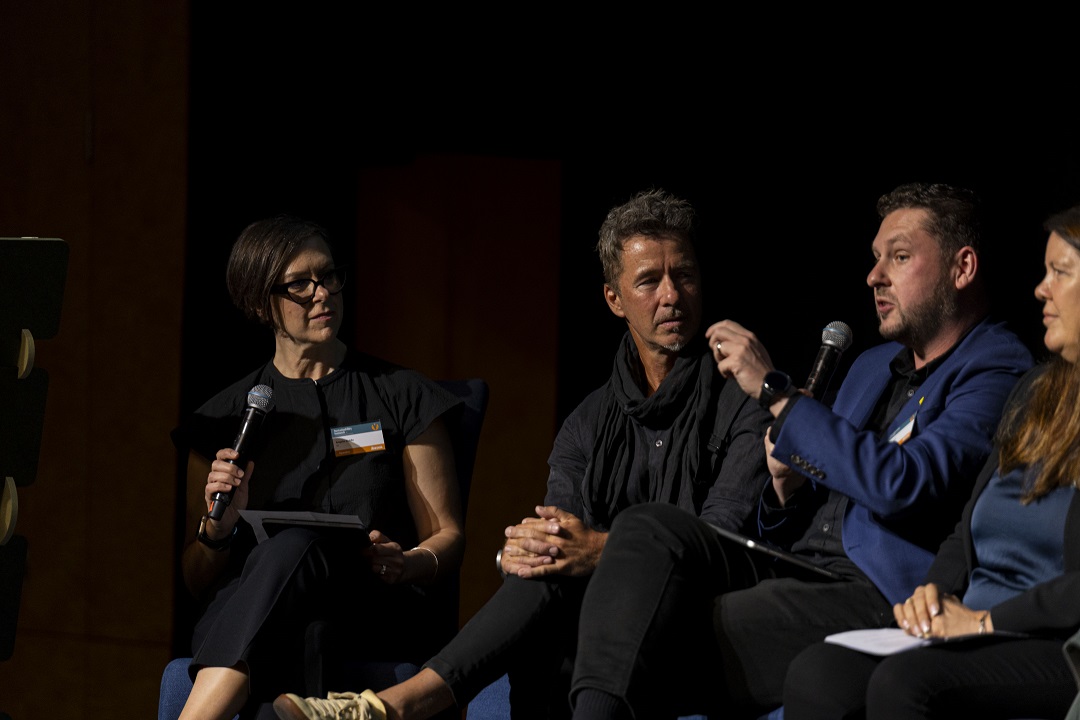
Similarly, moderator and FK Principal Angela Biddle recalled her work with a crisis accommodation redevelopment in Sydney, where they installed features that were standard practice in hotel design, including keycard access, door viewers and room safes, providing the residents not only a feeling of ownership but also of safety and security, transforming how they behaved in the space.
Designing with community: Reimagining environments for wellbeing
Most of the recent trends in the healthcare and workspace sectors from inclusion, cultural and social safety to mental health are evidence-based and represent a broader recognition that one size doesn’t fit all when designing spaces, observes WAM Principal Tamara White, and it’s giving people control and choice.
On inclusive design, White emphasises the importance of engaging with the community at the outset, “hearing what’s really important to them for a project, and then actually bringing that in and expressing it within the design”.
For the design of the Northcote Aquatic Centre, there was extensive community consultation including deep engagement with the local Wurundjeri community, resulting in interventions that embedded Indigenous cultural narratives highlighting the sacred kingfisher.
The resulting “joyful expression” in the building and architecture not only invites the community in but also creates a connection. Enrolments in the first few weeks touched 8,000 against the 3,000 expected to sign up for membership.
“The ripple effect of wellbeing in that community is really tangible and measurable,” White adds.
GECA’s Mark Barthel, who was involved in the London 2012 Olympics as part of the Sustainability team, recalls that there was a huge amount of community engagement because “it wasn’t just about the four weeks of the Games – it was about the legacy”.
To turn a 56-acre industrial hinterland into the single largest green urban space in Europe in 150 years, the venues were designed and developed to encourage public fitness and community wellbeing in the post-Games period, with cycle and walking paths, public transport and other amenities provided to improve accessibility to the area from the five London boroughs surrounding the Olympic Park.
“That, for us, was a real game changer, because we were able to engage with the whole value chain, resulting in an incredible outcome.”
Rethinking workplace design: Trends and practices
According to Aimee Munro from Gray Puksand, the agile workplace as a design principle may not have suited every organisation but it introduced substantial opportunity in workplace design because “working wasn’t just bound to a desk”. During the COVID years, working from home or hybrid working was a natural evolution, enabling many organisations to organically transition into a hybrid model.
Recent trends have also brought into focus the need to consider neurodiversity in workplace design, given that about 11% of the Australian workforce has been diagnosed as neurodivergent. These are people with a really great perspective, and are actually quite critical to business, says Munro, emphasising the need to support them within the workspace.
At a recent workplace project by Gray Puksand, a very specific sensory design was established that was applied to about 15% of the rooms on each floor of the building. Sensory features included low contrast finishes, low tactility, biophilia through natural finishes, planting and adjustable light levels, creating spaces with less sensory input for neurodivergent people to retreat to and reset.
To address the shift from agile to hybrid working, White says they have developed “etiquette-based working”, which is centred around changing the behaviours about how you actually engage in the workplace. In terms of design, it’s about creating more diversity of space, and layering the spaces from public to semi-private to private, and not putting collaboration spaces next to focused work areas, for instance.
Materiality for wellbeing: The new sustainability blueprint
“We’re seeing a second wave of sustainability,” says Jack Noonan from IWBI, and it’s focused on interaction between people and the planet.
What is a “healthy building”? he asks. Extrapolating from the World Health Organization’s definition of health as a state of complete physical, mental, and social wellbeing, not merely the absence of disease or infirmity, he says the fact that the building isn’t sick doesn’t mean that it is a healthy building.
Given that the built environment is one of the key determinants of our state of health and wellbeing, he says building practitioners have a responsibility to create spaces that make people using them healthier.
One area that presents a really big opportunity is acoustics or acoustic comfort, and Australia, Noonan says, shows average performance just like the rest of the world. Post-occupancy evaluation data reveals that while satisfaction is increasing on all indoor environmental quality parameters, in acoustics, it’s actually going backwards – a fact backed by two different studies by the University of Melbourne and Leesman.
The primary reason for the average acoustic performance in Australian workspaces is that people exposed to hybrid work environments are having higher expectations around acoustics in the workplace after working from home. Another reason, according to Leesman, is that corporate offices, since the pandemic, have reduced the amount of space for focused work while significantly increasing collaboration-type spaces. However, employees spend most of their time in the office on focused work, leading to complaints about acoustic comfort.
Materiality is another important factor in the delivery of a healthy building. Materials, says Noonan, have a huge impact on acoustic performance, lighting and indoor air quality. From a material’s perspective, third-party certifications like GECA bring transparency to an environment where many workplace projects in Australia use materials with high levels of formaldehyde.
Even in spaces that are done right and have great indoor air quality, it’s important to educate the users of the building on maintenance, observes Gibney. “Even if you produce a space that’s zero VOC, the air quality’s great until the cleaners come in twice a week – and you’ve just created an environment that is toxic right away.”
“It’s not good enough just to specify healthy materials – you actually have to test the quality of the air,” adds Noonan, emphasising the need for ongoing performance measurement of these spaces.
Health and wellbeing in the built environment: Making circularity compelling for clients
The global circularity rate is just below 7% across all industries, and much lower in Australia at around 4.4%, informs Barthel. The government’s circular economy framework seeks to double circularity by 2035, which will deliver extraordinary benefits in terms of $26 billion added value in the economy as waste is turned into materials for reuse, greenhouse gas emissions reduction by about 14%, and keeping 14-15 million tonnes of waste out of landfill.
“Circularity is all about maintaining the flow of materials in the economy at their highest value. It’s all about using regenerative design, closed-loop thinking and natural regeneration, all of which deliver on health and wellbeing,” comments Barthel.
A recent workplace design project by Gray Puksand for Perpetual saw a large inventory of furniture being repurposed and sent to schools and community workspaces, an action that the clients were really happy to support, says Munro. They also used recycled plastic and post-consumer recycled plastic as joinery material extensively, not only reducing waste but also enriching the visual identity of the workplace in a way that supported creativity and wellbeing.
Cost perceptions significantly influence decision-making, adds Veldman. While clients and contractors often believe sustainable materials or circular strategies cost more, many yield long-term savings or lifecycle benefits that outweigh initial costs. The designer’s role, therefore, is to reframe these assumptions to show that sustainability measures are financially viable and often more economical over the long term.
Post-occupancy evaluation of wellbeing: Tracking success
Barthel shares the outcomes of the London 2012 Olympics, where the transition from the Athletes Village to East Village, saw 2,800 homes being created including a significant portion of social housing. There has also been significant participation in sporting activity from the local communities, with younger people particularly embracing sport in high numbers. An innovation precinct created in East London today employs 40,000 people permanently. All of these outcomes have led to a whole series of health and wellbeing improvements for a very economically deprived part of London.
When designing the Perpetual workplace, Munro says collecting data from the company and employees helped establish clear and meaningful goals for the project. One of the issues that came up during the data collection was about the staff struggling with a sense of community in the workplace, given the hybrid work model and the office being on multiple floors.
These problems were addressed in the design by creating “teaming hubs” – mini-workplaces that could be booked by teams so that they could all work together on specific days. The post-occupancy data showed really great improvement in teaming and sense of community as well as an increase in attendance in the office, Munro shares.
At the Children’s Hospital in Sydney, attendance at the clinics has gone up since setting up the meerkat enclosure, says Veldman. “It works having distraction and discovery in a space that people may not want to come to.”
Noonan references a collaborative study conducted by the University of Melbourne, University of Wollongong, University of New South Wales, and University of Sydney that analysed occupant responses from several high-performance workplaces in Australia, Hong Kong, and Singapore. The research found that those workplaces that had a focus on health and wellbeing through a certification such as WELL made a significantly positive difference in the spaces in terms of reduced incidences of physical and mental ailments.
“I don’t think we need a metric to tell us that it’s a really good idea to build spaces and environments that contribute to health and wellbeing,” remarks Gibney. From a residential design perspective, he says, there are no metrics to conform to, so his practice works with clients to understand their motives, learn about their background and connect with them personally, with an aim to uncover deeper needs and create homes with unique spaces that support behavioural change, particularly around lighting, orientation and sensory experiences.
“For us, the post-occupancy metric is meeting them afterwards and discovering if habits have changed, and whether they are enjoying living in the space,” he concludes.
This panel was sponsored by our partners Knauf and Nero Tapware.
Sign up now to receive updates for the 2026 Sustainability Summit – where practitioners, thinkers, and community leaders will continue shaping the future of sustainable design.
Image: (L-R) Angela Biddle, Jason Gibney, Jack Noonan, Tara Veldman, Aimee Munro, Mark Barthel and Tamara White
