-
9 January 2026
The annual Sustainability Summit offers built environment professionals a full day of CPD-accredited learning, bringing together industry leaders to share practical strategies and inspirational ideas on driving positive change for a sustainable and resilient future. Through presentations, panels and networking, attendees gain insights into the innovations transforming how Australia designs, builds and lives sustainably.
Retrofit, refurb or rebuild?
As cities confront climate targets and ageing building stock, the panel examines the universal dilemma of demolition versus retrofitting, and how retaining and reimagining existing buildings can deliver resilience, meaning and measurable value beyond simple preservation – an act of transformation that balances embodied carbon, cultural memory, economics and future use.
Moderator Yvonne Haber of Yvonne Haber Architect opens the discussion by framing the challenge with a simple architectural question: If the building is viable to keep, how good is it in its bones? Deciding which parts to keep, how to keep, and what to discard demands a very strong balancing act between heritage value, embodied energy and structural strength, she opines.
For FK Principal Jessica Lee, retrofit projects are not about data or numbers, rather, they are about purpose. One of her early projects involved two building towers in midtown Brisbane that were built in the 1970s and were actually known as the ‘Ugly Sisters’. The brief sought to reuse the existing structure, turn the two square-box towers into one big contiguous structure, and add six storeys on top – because the buildings could support the addition.
“That was about adding value to an ageing CBD asset by meaningfully repurposing the dated building. The Ugly Sisters look beautiful now. Old bones, new look,” Lee reflects.
Another building in the Brisbane CBD takes the retrofit idea further, using less concrete, and adding mass timber on top to keep it light.
Asked what sustainability targets drove these projects, Lee responds that the project was driven by the demand for PCA A-grade commercial space with future tenants seeking office buildings that deliver amazing facilities and also hit sustainability metrics. Performance benchmarks, she adds, are no longer optional – they are market expectations.
Heritage as transformation, not status quo
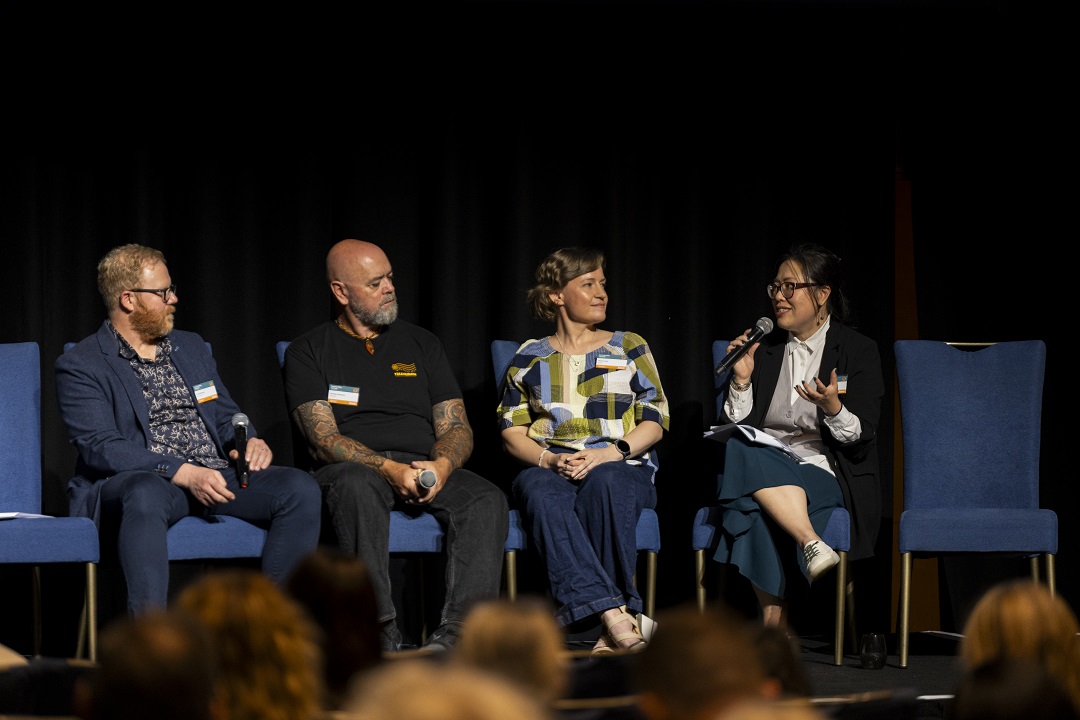
Christian Hampson, CEO and Design Lead, Yerrabingin, offers a broader perspective of urban design led by Country and rooted in resilience, transformation and cultural continuity. Instead of staying static, heritage assets should be transformed to create new value – environmental, social or cultural. It’s not just about physical heritage, he explains, it’s also the opportunity “to have new stories for people to access past knowledge through these buildings”.
For many Aboriginal communities, many of these buildings also carry traumatic memories. Retrofitting can be an act of healing – transforming these buildings in a contemporary and sustainable way can help create social spaces that are accessible and reflective of modern culture.
Heritage is all about passing on what we value to future generations, says Hampson. However, people are also scared about getting involved with heritage projects because of the expense. Several Aboriginal communities that own heritage assets have struggled to get investment, resulting in developers buying off the assets whereas the communities may aspire to create their own fingerprint within those spaces.
Community, consultation and sense of place
Heritage, observes Haber, is not just “beautiful old buildings”, but also about how people emotionally relate to these buildings. “Sometimes it’s traumatic. So, how do we reinvent something so it becomes positive rather than negative?” she asks.
Talking and listening to the community is a good starting point for any project, says Eloise Doyle, Senior Sustainability Consultant, Aurecon.
Her experience on the Redfern Station upgrade demonstrates how consultation shapes outcomes. An unused brick building was repurposed as a station entrance, following a detailed heritage audit. Different elements of the existing station were identified, timber beams removed and reinstated, the bricks strengthened, and machinery retained. Through continuous consultation with local residents as well as Aboriginal communities, Indigenous designers were engaged, and Aboriginal history was embedded into the fabric of the concourse – from pavement to parkland.
“If you stand there now, there’s a story everywhere,” Doyle says. “You just feel such a strong sense of place, which gives incredible value, and you just want to go there.”
When retrofit isn’t simple – or cheap
Joel Williamson, National Commercial Sales Manager at flooring company GH Commercial offers a pragmatic counterpoint to the retrofitting discussion, observing – from personal experience – that not all buildings are easy to save.
A large sporting, not-for-profit community organisation, where he serves as a board member, operates a gymnastics centre in a regional area from an old steel shed built in the 1980s. Not only was the cost of heating and cooling this space extremely high, even retrofitting the inefficient shed proved financially daunting. For a not-for-profit, the economics sometimes favour demolition and rebuilding with modern insulation, and heating and cooling systems that would make the building more efficient to run well into the future.
However, demolition also carries a heavy embodied carbon cost, comments Haber. So how do architects determine whether a building should be preserved and brought up to current environmental standards for the new use, or demolished and rebuilt as a new building?
Lee responds with a concrete example: The Alba project in South Melbourne, where a 1970s commercial office tower owned by Australian Unity was converted into a vertical aged care facility that became part of a co-located master plan for a seniors’ living precinct.
The quantity surveyor’s calculations found that it was 15% cheaper to retrofit the building than build from scratch after demolition. Cost wasn’t the only benefit, Lee reveals – the embodied carbon in the building was preserved by retaining the structure.
Financing the green transition
Refurbishing or retrofitting buildings involves a lot of expense, says Doyle, highlighting potential structural issues, seismic impacts, wind loads and fire safety, among many more considerations. However, the cost factor can be addressed through emerging funding mechanisms such as green loans, green bonds and council incentives that reward retention and low-carbon outcomes. Greater awareness of these funding channels can unlock financing and improve project viability, she adds.
Social value beyond the balance sheet
Perhaps the most compelling reason for retrofit is not financial or environmental, but social. Lee notes that the Alba project, which converted the Australian Unity office into an aged care and allied health services building in an inner-city suburb of Melbourne, generated millions of dollars in social value in its first year through improved healthcare access, wellbeing, and age-appropriate housing.
“This is about regenerating an existing structure into housing that’s needed within the space,” she says, “and creating jobs for that area.”
Storytelling as design strategy in heritage retrofits
Every project begins with a thorough site analysis, says Lee, which gives the architects a contextual feel about the neighbourhood. At a seniors’ living development that FK is working on currently, they have retained an old Queenslander home, which doesn’t have any heritage value but has plenty of nostalgia for future residents. The home has been repurposed as the lobby of the new three-storey apartment building and will serve as the communal lounge, providing an emotional connection to the homes where these residents lived in for decades and raised their families.
“The narrative was really to keep the context, but also work with the context,” explains Lee. They were able to convince the client about the value of retaining the character home in the project. “As architects, we’re taught to tell stories,” she says, “and this is a great story to start with.”
Adapt or rebuild: Treading the fine line
At the end of the day, it all comes down to the question: What’s the maximum opportunity in the site? Early investigations, yield studies and expert inputs can help architects decide between adaptation and demolition. Density, for instance, comes into play in locations that need housing supply, Lee says, taking the example of a site that had three houses, which were demolished to build 30 apartments. The project involved a lot of community consultation, resulting in a building with a low residential scale that also made room for more people to live in a place that they want to live.
However, when it comes to a CBD tower, the first question would be: What can I keep? Every assumption, says Lee, must be validated with real data to be able to convince the client that the building is worth keeping and doesn’t need to be demolished.
Hampson sees rebuilding as an opportunity to repurpose materials from the demolition in different ways. “That’s where the story is,” he says, “and we’d love to have it woven together with the building, so the building is actually part of Country.”
According to Williamson, the products that are telling stories, the products that are connected to Country, and the products that are in their right place, tend to be the longest-lasting products. When a product fits a space, has a purpose and tells a story, there’s less likelihood of the product being changed out regardless of colour or design trends, he explains, because “this product exists in this space for a reason”. It’s also so much less wasteful, he adds.
Hampson also emphasises the importance of heritage assets not only to exemplify our cultural history and legacy but also to be continually useful. “We are always evolving and remaining resilient, therefore, these buildings have to evolve and remain resilient to contribute to society. Otherwise, they’re just holding a static space when everything else is moving forward.”
Regulating retrofits: The hidden barrier
Despite best intentions, regulation often complicates retrofits, especially in non-heritage buildings, says Lee as she calls for a smoother process to achieve certification. At the Alba project in Melbourne, changing the building’s classification from office to aged care triggered full compliance requirements, effectively treating the old building as a completely new project being built from scratch. This turned out to be highly challenging because they were working with existing bones and not from a blank canvas.
Calling for greater government support for heritage upgrades, Hampson refers to the UK and Europe where state lottery funds huge heritage projects for cultural and tourism outcomes.
“If the New South Wales State Lottery was still owned by government, and half of it was spent on retrofitting buildings, we’d have an amazing collection of places,” he notes.
This panel was sponsored by our partner, GH Commercial.
Sign up now to receive updates for the 2026 Sustainability Summit – where practitioners, thinkers, and community leaders will continue shaping the future of sustainable design.
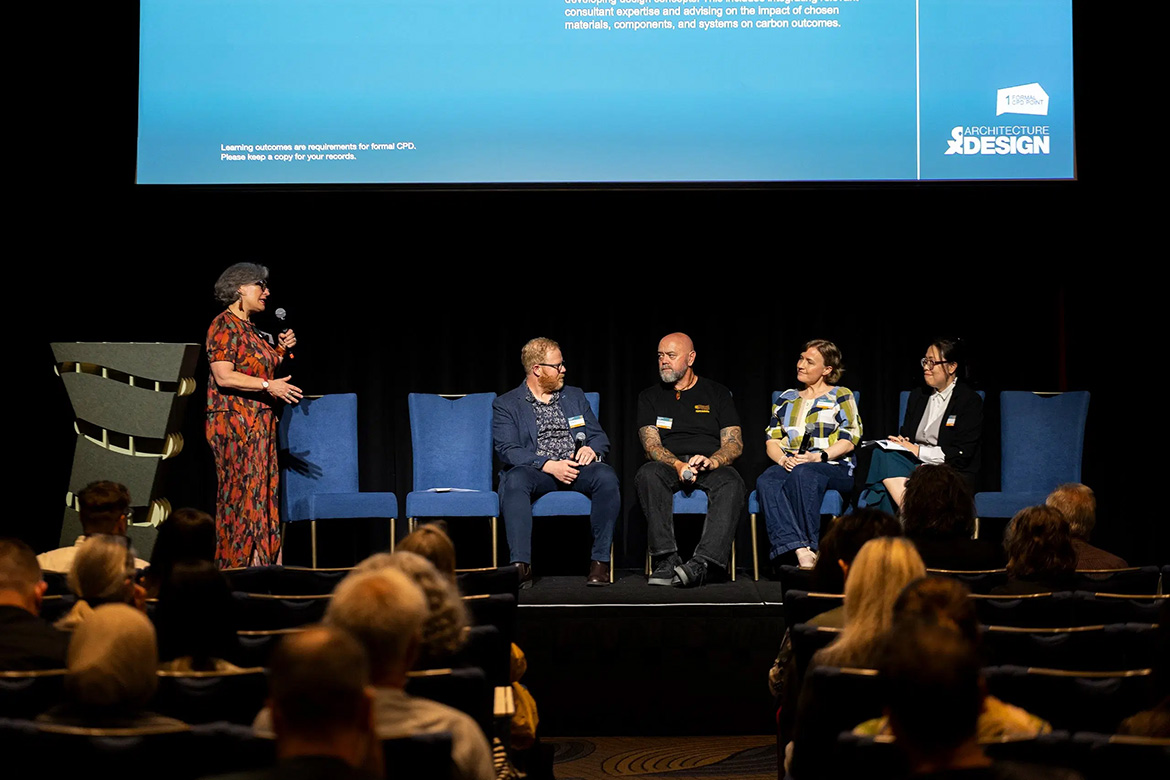
Main image: (L-R) Yvonne Haber, Joel Williamson, Christian Hampson, Eloise Doyle and Jessica Lee
